🌬️ Air Filter Performance Matcher
Stop chasing raw CFM numbers. Use this tool to determine if a filter actually matches your engine's real-world breathing needs and reliability requirements.
Your Engine Profile
Compare Filter Options
You’ve probably seen it in every car forum thread: "Get a high-flow filter! It adds horsepower!" The logic seems simple-more air equals more power. But here’s the catch: if you just swap your stock paper filter for a giant open cone with maximum CFM, you might actually be slowing your engine down or breaking your sensors. Cubic Feet per Minute (CFM) is a measurement of volumetric flow rate indicating how much air passes through a component per minute. While higher numbers look impressive on a spec sheet, they don’t tell the whole story about how that air interacts with your engine’s specific needs. The real question isn't "Can it pass more air?" but "Does it restrict airflow at the exact RPMs where my engine makes peak torque?" Let’s break down why chasing the highest CFM number can backfire and what metrics actually matter when choosing an intake system.
The Myth of Unlimited Airflow
To understand why more CFM isn't always better, we have to look at how engines breathe. An internal combustion engine is essentially an air pump. It pulls air in, compresses it, mixes it with fuel, and ignites it. The amount of air it can pull is limited by its physical displacement and efficiency, not by how much air *could* theoretically fit in the filter. Consider a typical 2.0-liter turbocharged engine. At its redline, it might consume around 400-500 CFM of air under boost. If you install a filter rated for 1,000 CFM, does that extra capacity help? Not really. The bottleneck isn't the filter; it's the throttle body, the intercooler piping, or the compressor wheel itself. In this scenario, the massive CFM rating is marketing fluff. You’re paying for capability you’ll never use, while potentially sacrificing other critical performance factors like filtration quality and noise control.
Restriction vs. Flow: The Real Battle
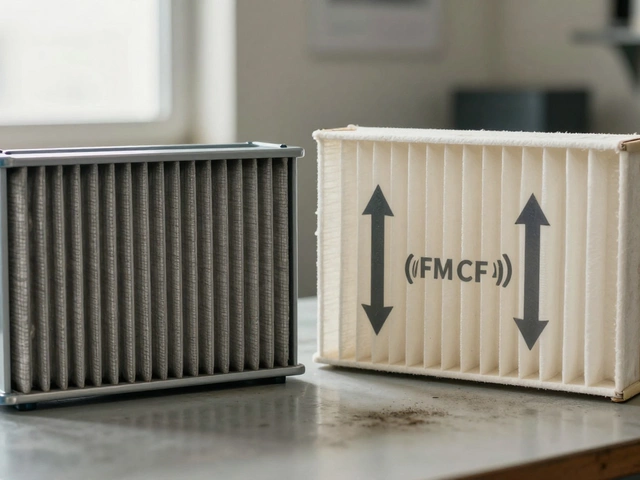
If raw CFM doesn't equal power, what does? The answer lies in Pressure Drop is the loss of pressure as air moves through a restriction, measured in inches of water column (inH2O). This is the metric that directly impacts engine breathing efficiency. When air hits a filter media, friction occurs. High-quality performance filters are designed to minimize this friction. A good rule of thumb from industry standards is that a filter should not exceed a pressure drop of 1.0 inH2O at the engine’s maximum airflow demand. If your filter restricts flow significantly, the engine has to work harder to pull that air in, which consumes energy and reduces net horsepower. However, there’s a trade-off. Open-element filters (like those made from oiled cotton gauze) offer extremely low restriction because they have large gaps between fibers. Paper filters have tighter weaves. This means paper filters naturally have higher restriction than open elements. So, why do many tuners still recommend paper-based performance filters? Because of the next critical factor: particle capture.
The Filtration Trade-Off
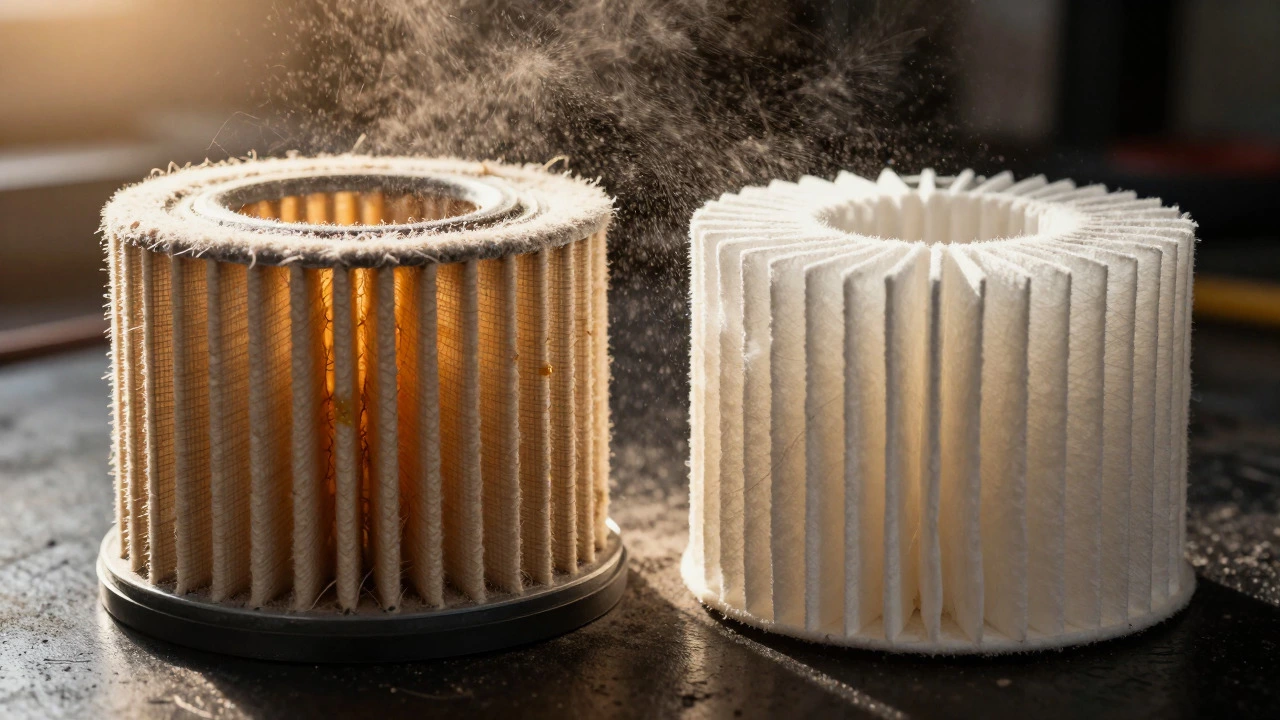
Air isn't clean. It contains dust, pollen, bugs, and tiny debris. If your filter lets all that junk into your engine, you’re trading short-term airflow gains for long-term engine damage. Turbines, especially, are precision-machined components that hate grit. Filtration Efficiency is the percentage of particles of a certain size captured by the filter media. A standard K&N-style oiled filter typically captures about 98% of particles larger than 10 microns. A high-end dry paper filter might capture 99% of particles down to 5 microns. That 1% difference sounds small, but over 100,000 miles, it can mean the difference between a pristine turbo and one with scored compressor blades. This brings us to the core dilemma: Do you want the absolute lowest restriction (highest potential CFM) or the best protection for your expensive engine internals? For most street-driven performance cars, the latter is often the smarter choice. You gain reliability and longevity, which allows you to run more boost safely without worrying about unfiltered grit destroying your investment.
MAF Sensor Accuracy and Tuning Challenges
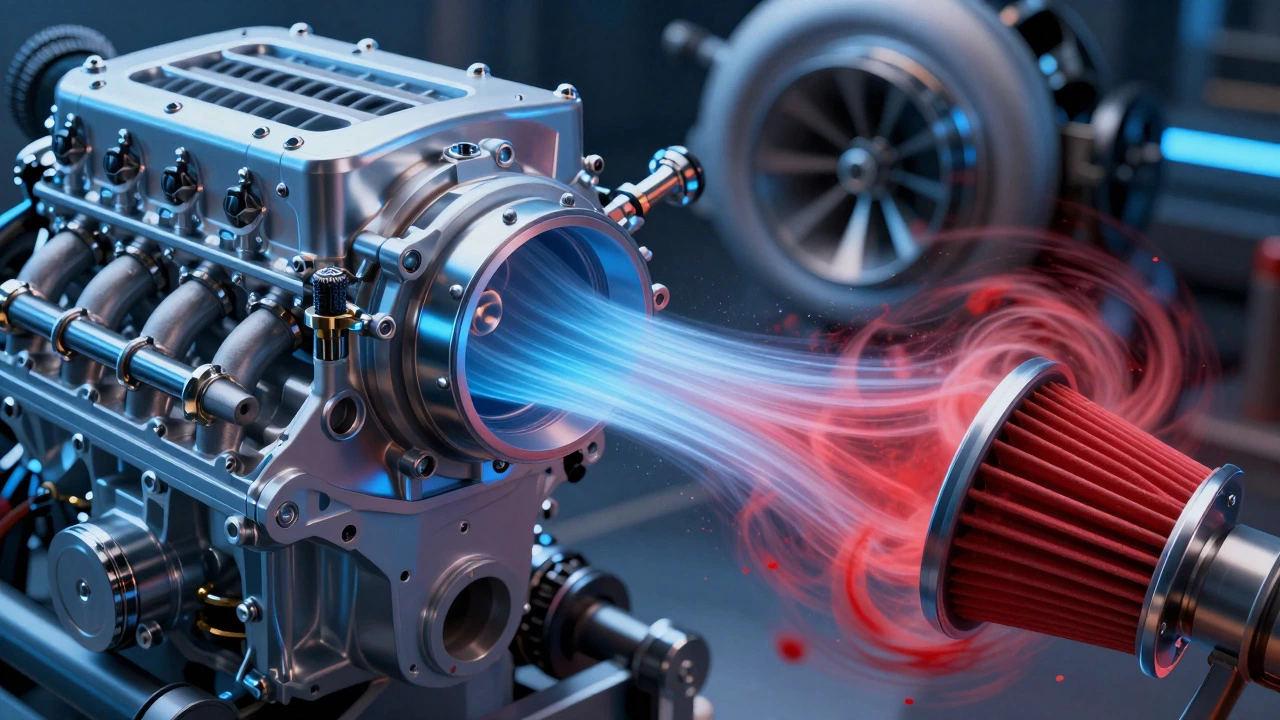
Here’s a problem many enthusiasts overlook until their check engine light comes on. Modern engines rely on a Mass Air Flow (MAF) sensor to calculate how much fuel to inject. This sensor measures the density and volume of incoming air. When you change your intake system, you alter the airflow dynamics. A high-CFM open cone filter creates turbulent airflow. Instead of smooth, laminar flow, the air swirls and vortices form inside the intake tract. This turbulence confuses the MAF sensor. It may read lower than actual airflow, causing the Engine Control Unit (ECU) to lean out the mixture. A lean burn can lead to detonation, overheating, and head gasket failure. To fix this, you need a custom tune. But even with a tune, some drivers report inconsistent readings or lag in throttle response compared to smoother-flowing systems. This is why many professional shops now prefer hybrid solutions: filters that balance high flow with structured airflow channels to keep the MAF happy without extensive recalibration.
Comparing Filter Types: Data Over Hype
Let’s look at some realistic data points to illustrate the differences. Below is a comparison of common intake filter types based on typical performance characteristics found in independent testing labs.
| Filter Type | Typical Max CFM (Stock Intake) | Pressure Drop @ 500 CFM | Filtration Efficiency (10 micron) | Maintenance Requirement |
|---|---|---|---|---|
| Stock Paper Filter | ~350-400 CFM | 1.5 - 2.0 inH2O | 99% | Replace every 20k-30k miles |
| Oiled Cotton Gauze | ~600-700 CFM | 0.8 - 1.0 inH2O | 98% | Clean and oil every 15k-20k miles |
| Dry Paper Performance | ~450-500 CFM | 1.0 - 1.2 inH2O | 99% | Replace every 30k-40k miles |
| Open Element (No Media) | Unlimited (Intake Limited) | < 0.5 inH2O | Low (Debris Risk) | None (but high risk) |
When Does More CFM Actually Matter?
So, is high CFM ever useful? Yes, but only in specific scenarios. If you are building a high-revving naturally aspirated engine that breathes hard at 8,000+ RPM, or a heavily modified turbo setup pulling over 1,000 CFM of ambient air, then the stock filter becomes a genuine bottleneck. In these cases, the restriction caused by a standard paper filter can cost you measurable horsepower. For example, a 2JZ-GTE engine making 400+ wheel horsepower on a single turbo might see a 2-3% gain in airflow efficiency by moving from a restrictive stock box to a high-flow conical filter. That 3% can translate to 10-12 extra horsepower. But for a stock 3.5L V6 making 280 horsepower, that same filter upgrade might yield less than 1% gain, barely noticeable behind the wheel. The key takeaway is context. Match the filter’s flow capacity to your engine’s actual demand. Don’t buy a filter rated for 1,000 CFM for an engine that only uses 400. You’re not buying power; you’re buying a bigger hole.
Practical Tips for Choosing the Right Filter
Before you go shopping, follow these steps to ensure you get the right part for your build:
- Calculate Your Engine’s Max Air Demand: Use a displacement calculator or consult your tuner. Know how much air your engine pulls at peak load.
- Check Pressure Drop Ratings: Look for filters that specify pressure drop at your engine’s max airflow. Aim for under 1.0 inH2O.
- Evaluate Your Driving Conditions: Do you drive on dusty rural roads? Stick to dry paper or high-efficiency media. Do you mostly drive on highways? Oiled gauze is fine if you maintain it.
- Consider Noise Levels: High-flow intakes often let in more engine noise and road noise. If you value cabin quietness, a boxed system with a resonator is better than an exposed cone.
- Plan for Maintenance: Oiled filters require cleaning. If you hate maintenance, choose a disposable paper performance filter.
Does a higher CFM rating always mean more horsepower?
No. Horsepower depends on how efficiently the engine can use the air available. If the engine doesn't need the extra airflow, the higher CFM rating provides no benefit. In fact, poor airflow dynamics from oversized filters can confuse the MAF sensor and reduce power if not tuned correctly.
Are oiled cotton filters better than paper filters?
It depends on your priority. Oiled filters generally offer lower restriction (higher flow) but capture slightly fewer fine particles. Paper filters offer better filtration and cleaner airflow for the MAF sensor but have higher restriction. For street cars, paper is often safer for engine longevity; for track cars, oiled may provide a slight flow advantage.
What is a safe pressure drop limit for an air filter?
Industry consensus suggests keeping pressure drop below 1.0 inch of water (inH2O) at the engine's maximum airflow requirement. Exceeding this limit means the engine is working too hard to draw air in, resulting in lost power and efficiency.
Do I need to re-tune my car after changing the air filter?
Ideally, yes. Changing the intake system alters airflow velocity and turbulence, which affects MAF sensor readings. Even if you don't notice immediate issues, a custom tune ensures the air-fuel ratio remains optimal across the entire rev range, preventing lean conditions and maximizing performance.
How often should I replace or clean my performance air filter?
For oiled cotton filters, clean and re-oil every 15,000 to 20,000 miles, or sooner if driving in dusty conditions. For dry paper performance filters, replacement is typically recommended every 30,000 to 40,000 miles. Always inspect the filter visually during oil changes to check for excessive dirt buildup.