Headlight Upgrade Simulator
Not sure if you should switch to LEDs? This tool analyzes your specific driving environment and vehicle setup to predict visibility improvements and potential legal/glare issues.
Simulation Results
Visibility Score
Glare Risk
Legal Compliance
Performance Analysis
Critical Warnings
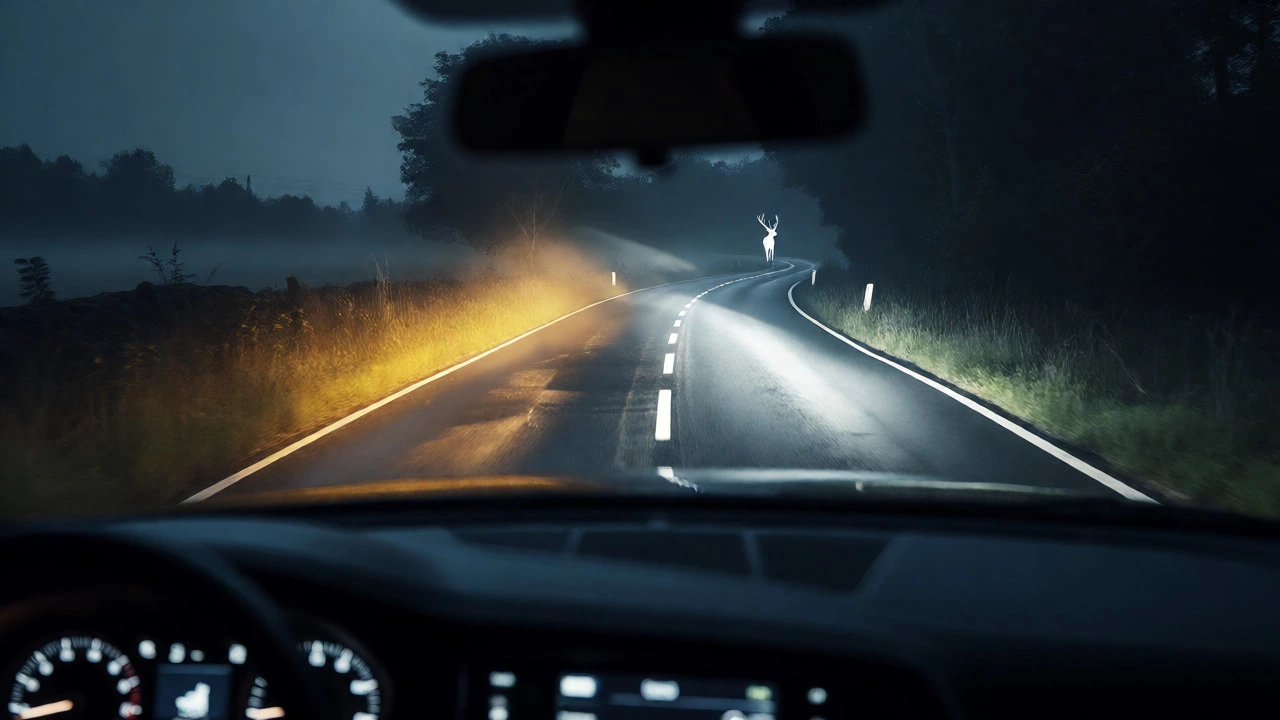
You’re driving down a dark country road at night. The high beams are on, but the world ahead looks like a blurry gray smear. You squint, trying to spot that deer or pothole before it’s too late. Then you remember your buddy just swapped his old bulbs for LED headlights. He claims he can see twice as far and that his eyes don’t ache after an hour of driving. Is he selling snake oil, or is there real science behind the hype?
The short answer? Yes, LEDs are generally better, but "better" is a loaded word. It depends entirely on whether you care about raw brightness, color temperature, energy efficiency, or legal compliance. If you slap a cheap $20 bulb into a reflector housing designed for halogens, you might actually make things worse for yourself and oncoming traffic. Let’s break down exactly what happens when you switch, so you don’t waste money or fail your next vehicle inspection.
Brightness and Color Temperature: The Visual Difference
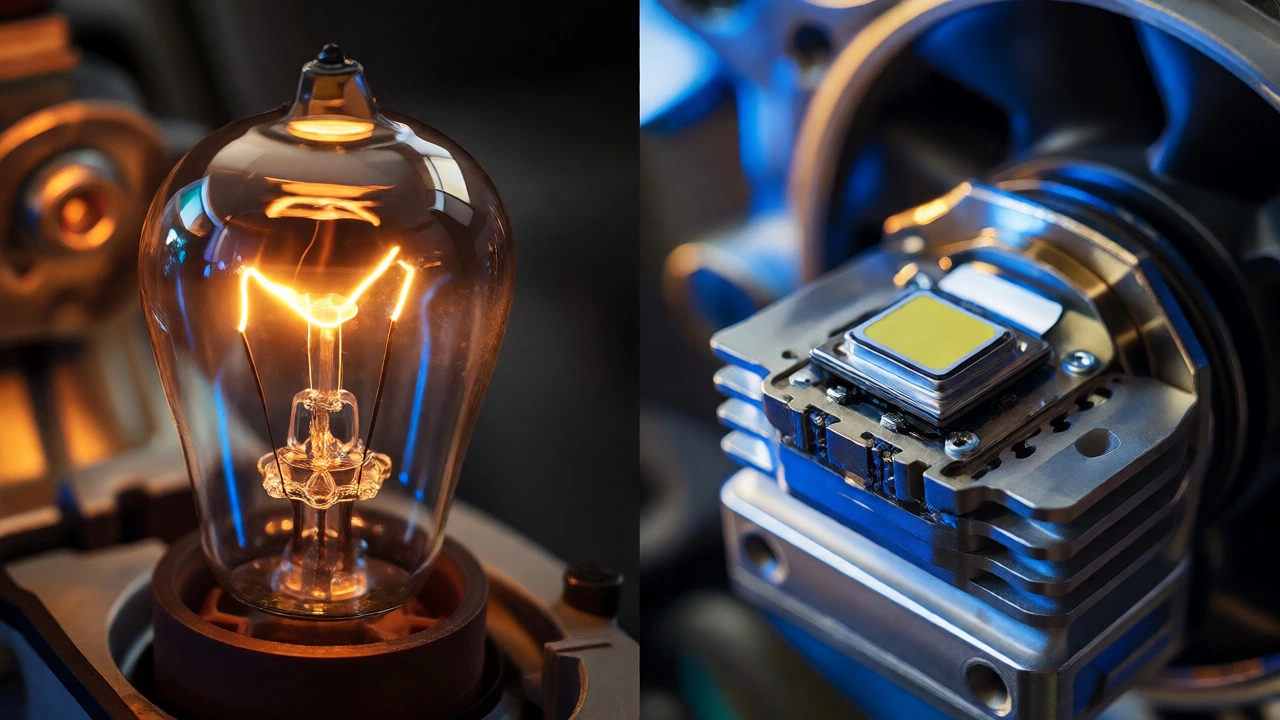
Let’s talk numbers, because marketing fluff doesn’t help you see the road. A standard halogen bulb produces about 1,000 to 1,500 lumens per pair. It runs hot-literally, it’s an incandescent filament glowing inside a gas-filled glass bulb-and emits a yellowish light around 3,000 to 4,000 Kelvin. That yellow tint cuts through fog well, which is why many drivers still prefer it in bad weather.
A quality LED headlight bulb, however, can push 6,000 to 8,000+ lumens per pair while drawing significantly less power. More importantly, they typically emit a cooler white light between 5,000K and 6,500K. This spectrum closely mimics daylight, which reduces eye strain during long drives. Your brain processes contrast better under neutral white light than under warm yellow light. That means you spot lane markers sooner and judge distances more accurately.
| Feature | Halogen Bulb | LED Headlight |
|---|---|---|
| Lumens (Output) | 1,000 - 1,500 lm | 6,000 - 10,000 lm |
| Color Temp | 3,000K - 4,000K (Yellow) | 5,000K - 6,500K (White) |
| Lifespan | 450 - 1,000 hours | 15,000 - 30,000+ hours |
| Power Draw | 55W - 60W | 15W - 25W |
| Heat Generation | High (Radiant Heat) | Low (Requires Heat Sink) |
The Beam Pattern Problem
Here is where most DIY upgrades go wrong. Your headlight assembly isn’t just a hole with a bulb; it’s an optical system. Older cars use reflector housings. These are shiny, parabolic mirrors designed to bounce light from a specific filament position outward in a precise pattern. Newer cars often use projector lenses, which focus the light more tightly.
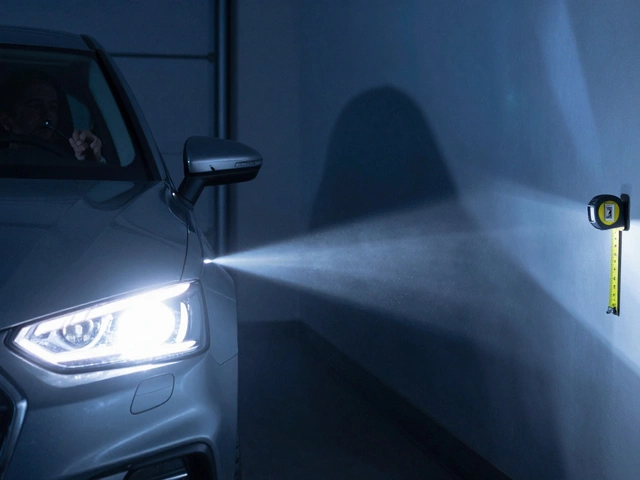
When you replace a halogen bulb with an LED, you change the physical size and shape of the light source. Halogen filaments are tiny points. LED chips are flat squares, often mounted on multiple sides of a metal core. If those chips aren’t positioned exactly where the halogen filament was, the light scatters. Instead of a sharp cutoff line that keeps glare out of other drivers' eyes, you get a messy blob of light. This creates two issues:
- Glare: Oncoming drivers get blinded by scattered light hitting their retinas directly.
- Poor Road Illumination: Light goes up into the sky instead of onto the asphalt. You think you have bright lights, but you’re actually seeing less of the road surface.
To fix this, you need CANbus-compatible LED bulbs with adjustable chip orientation. Some premium brands allow you to rotate the bulb within the socket to align the chips horizontally, matching the original filament plane. Without this adjustment, even the brightest LED will perform poorly compared to a correctly aligned halogen.
Lifespan and Reliability
If you hate changing bulbs, LEDs are a game-changer. A typical halogen bulb lasts about 500 to 1,000 hours. If you drive an hour a day, that’s a replacement every six months or so. Vibration kills them faster. Potholes and rough roads shake the delicate tungsten filament until it snaps.
LEDs have no filament. They are solid-state devices. Their failure mode isn’t sudden death; it’s gradual dimming over time. Most reputable manufacturers rate their products for 15,000 to 30,000 hours. In practical terms, this means the bulbs likely outlast the rest of the car’s electrical components. However, there is a catch: heat management. While LEDs generate less radiant heat than halogens, the diodes themselves get very hot. If the built-in fan fails or the heat sink gets clogged with dust, the LED overheats and dims prematurely. Cheap LEDs often lack proper thermal protection, leading to early burnout.
Installation Challenges and CANbus Errors
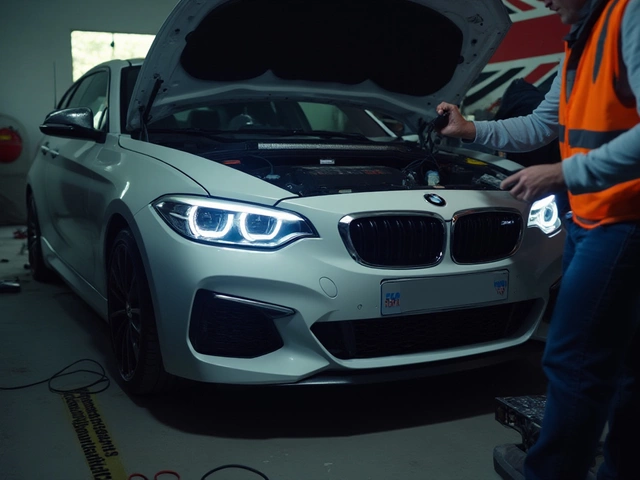
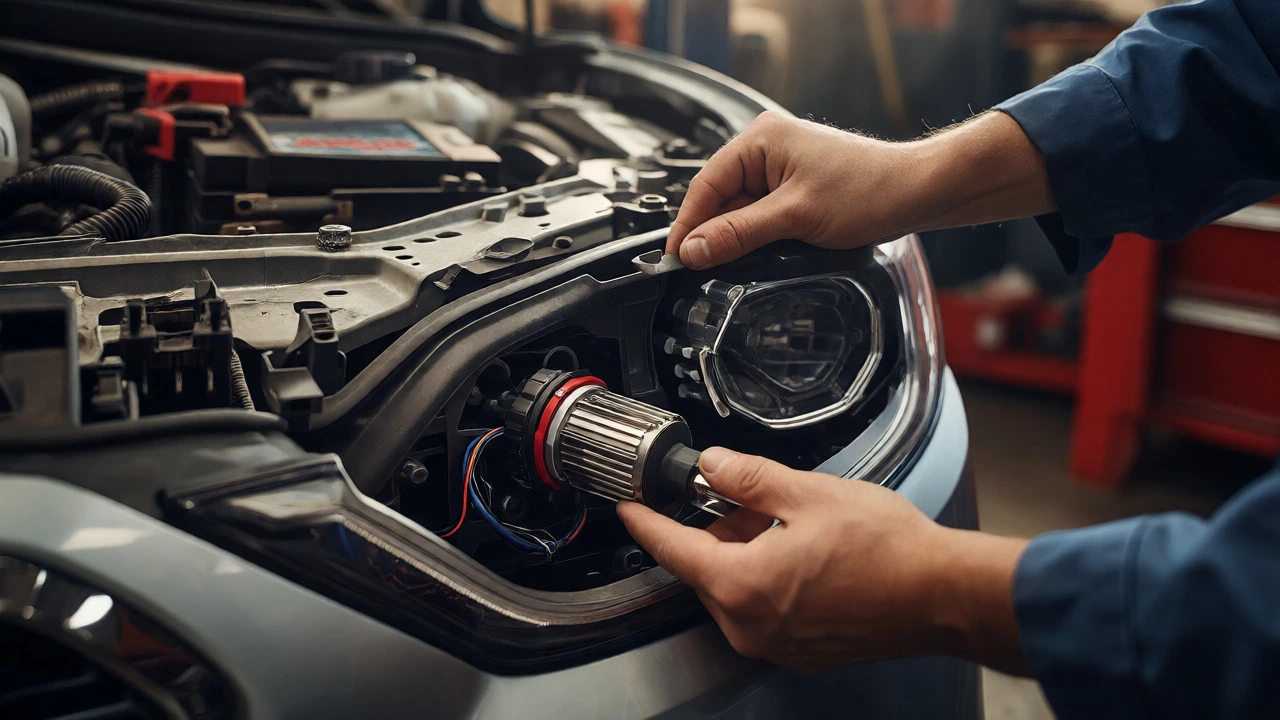
Modern vehicles monitor electrical loads. Your car expects a 55-watt draw from each headlight circuit. An LED bulb draws only 20 watts. The car’s computer thinks a bulb has burned out and triggers a dashboard warning light. Worse, some cars enter a rapid-flashing mode for turn signals or flicker the headlights.
To solve this, you have two options:
- Install Load Resistors: These dummy resistors trick the computer by adding back the missing wattage. They get extremely hot, so they must be mounted away from plastic parts or wiring looms. If they melt nearby insulation, you’ve created a fire hazard.
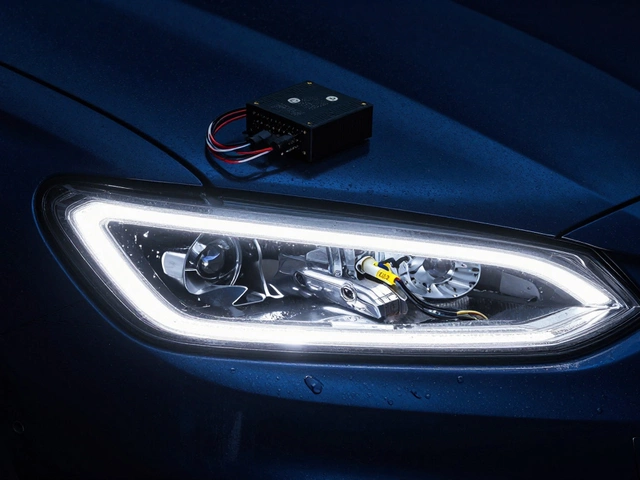
- Use Decoder Modules: Many modern LED kits come with plug-and-play decoders. These small boxes sit between the bulb and the factory connector, stabilizing the voltage without generating excessive heat. This is the cleaner, safer solution for European cars like BMWs, Audis, and Mercedes-Benz models, which are notorious for sensitive electrical systems.
Physical fitment is another hurdle. LED bulbs are bulkier than halogens. The driver side of many sedans has tight clearance due to the battery or air intake box. You might find that the rubber boot covering the back of the headlight won’t seal properly. Moisture ingress is the enemy here. If water gets inside the housing, it causes condensation and eventually ruins the reflective coating or shorts out the LED driver.
Legality and Inspection Standards
This varies wildly by location. In Australia, where I’m writing from, regulations are strict. Under Australian Design Rules (ADR), any modification to lighting must not exceed specified luminous intensity limits and must maintain the correct beam pattern. Simply swapping bulbs is technically a modification. If your new LEDs cause excessive glare or fail to meet the minimum lux levels at certain test points, you can fail a roadworthy inspection.
In the US, the FMVSS 108 standard governs lighting. The key rule is that the light output must match the certification label on the headlamp lens. If the lens says "DOT Halogen," putting in non-DOT compliant LEDs can technically make the vehicle illegal, though enforcement varies by state. Always look for bulbs marked "DOT Compliant." Note that this usually refers to the bulb being made in a DOT-certified facility, not necessarily that the specific combination passed lab testing for beam pattern. When in doubt, check local laws before buying.
When Should You Stick With Halogen?
Not every car needs an upgrade. If you live in a region with heavy rain, snow, or fog, the yellow spectrum of halogen penetrates atmospheric particles better than blue-rich white light. Blue wavelengths scatter more easily (Rayleigh scattering), which is why the sky is blue. In dense fog, a crisp 6,000K LED can create a "white wall" effect, reflecting off the mist and blinding you. For these conditions, keeping halogens or using dedicated yellow fog lights alongside white main beams is often smarter.
Also, if your headlight housings are old and cloudy, upgrading bulbs won’t help much. Polishing the lenses or replacing the entire assembly yields better results than fighting physics with a new bulb. And finally, if you drive an older Japanese import with basic reflector bowls, a high-quality halogen bulb from a brand like Philips X-tremeVision might give you 90% of the benefit with zero hassle.
Frequently Asked Questions
Do LED headlights drain the car battery?
No, they actually reduce load. LEDs consume significantly less power than halogens. This puts less stress on the alternator and can slightly improve fuel economy in older vehicles, though the difference is negligible in modern cars with efficient charging systems.
Why do my LED headlights flicker?
Flickering is usually caused by incompatible electronics. Modern cars use pulse-width modulation (PWM) to control brightness, which confuses simple LED drivers. Installing a decoder module or a CANbus adapter stabilizes the current flow and stops the flicker.
Are LED headlights bad for oncoming drivers?
They can be if installed incorrectly. Poorly aligned LEDs in reflector housings scatter light upward, creating glare. Properly adjusted LEDs with a sharp cutoff line are actually less glaring than misaligned halogens because the light is directed precisely where needed.
Can I put LED bulbs in projector headlights?
Yes, and they often work better than in reflector housings. Projectors focus the light, reducing scatter. However, ensure the LED chip size matches the focal point of the projector. If the emitter is too large or positioned incorrectly, the beam pattern will still be distorted.
How long do LED headlight bulbs last?
Quality LED bulbs are rated for 15,000 to 30,000 hours. This translates to several years of daily driving. Unlike halogens, they rarely burn out suddenly; instead, they gradually lose brightness over time due to thermal degradation.