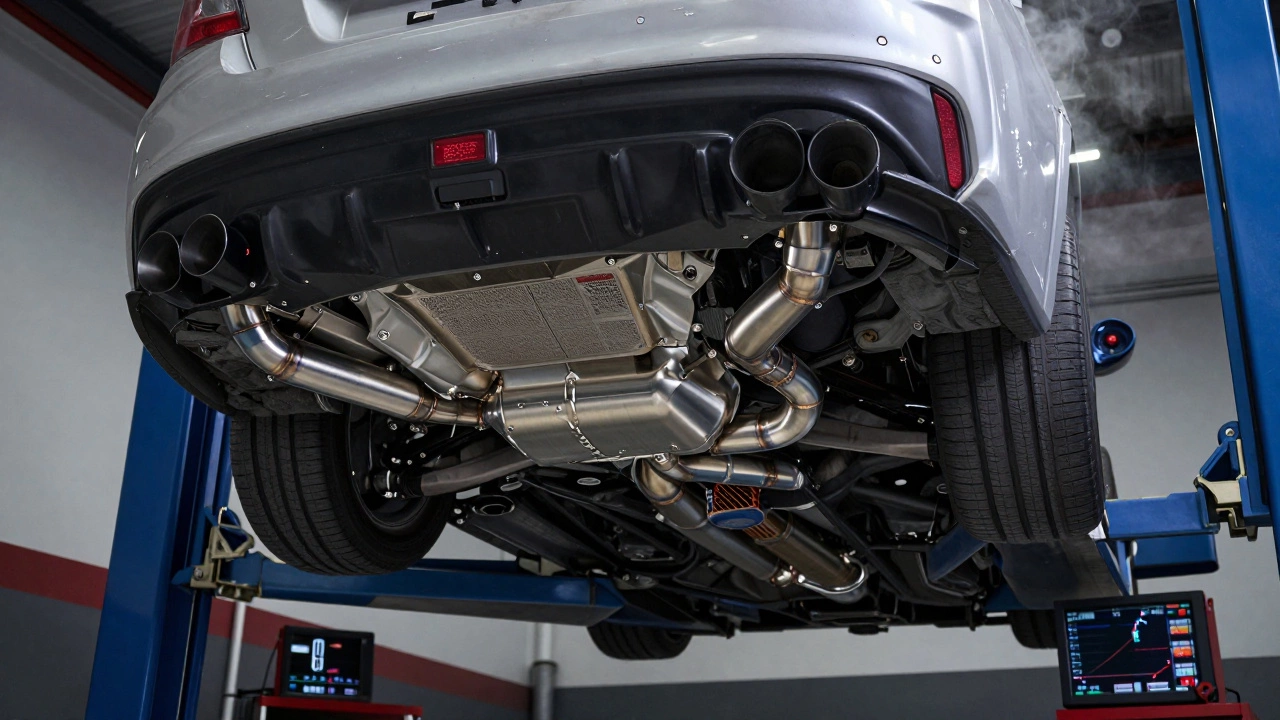
Exhaust Size: What Really Matters for Performance and Sound
When people talk about exhaust size, the diameter of the pipes in a car’s exhaust system that directly impacts airflow, engine performance, and noise levels. Also known as exhaust diameter, it’s not just about making your car louder—it’s about whether the pipe width matches your engine’s needs. Too small, and you choke the engine. Too big, and you lose low-end torque. Most factory exhausts are sized for emissions and quiet operation, not power. Upgrading isn’t just swapping in a louder pipe—it’s matching the right size to your car’s setup.
For daily drivers, a 2.25-inch to 2.5-inch exhaust system usually gives the best balance of flow and backpressure. That’s what most stock 4-cylinder and V6 engines run on, and going bigger often doesn’t help unless you’ve added a turbo or supercharger. On the other hand, straight pipe exhaust, a system with no muffler or catalytic converter, designed for maximum flow and minimal restriction is common in race builds but rarely legal on public roads. In Australia, for example, noise regulations and emissions standards make many straight pipe setups non-compliant, even if they sound awesome. And don’t assume bigger always means better—aftermarket exhaust, any exhaust system replaced from the factory, often sold for performance or aesthetic reasons can be poorly designed. Some brands just sell louder pipes without tuning the diameter for your engine’s RPM range.
The real trick is understanding how exhaust system, the full path exhaust gases take from engine to tailpipe, including headers, catalytic converters, mufflers, and pipes works as a whole. Changing just the tailpipe won’t do much if your headers or catalytic converter are still restricting flow. A 3-inch exhaust might sound great, but if your engine only makes 200 horsepower, you’re wasting money. Performance gains come from matching the entire system to your car’s output. That’s why many pros recommend starting with headers and a high-flow catalytic converter before upgrading pipe size.
And don’t forget legality. In the UK and Australia, loud exhausts can get you fined—not just for noise, but for missing emissions components. A 3-inch system might be fine on a tuned WRX, but on a 1.5-liter Civic? It’s overkill and likely illegal. The best upgrades are the ones that improve performance without drawing attention from the cops. That’s why so many people end up choosing a 2.5-inch system with a quality muffler—it’s quiet enough for the neighborhood, but still lets the engine breathe.
What you’ll find below are real-world tests and experiences from people who’ve tried different exhaust sizes on real cars. No theory. No marketing fluff. Just what actually works on the road, what doesn’t, and why some upgrades cost more than they’re worth.
A 3-inch exhaust isn't automatically better-it's only an upgrade if your engine makes over 350 horsepower. Learn when it helps performance, when it hurts, and what size actually works for your car.